|
Questions & Answers
Click
here for a
fully formatted PDF version of these Qs & As.
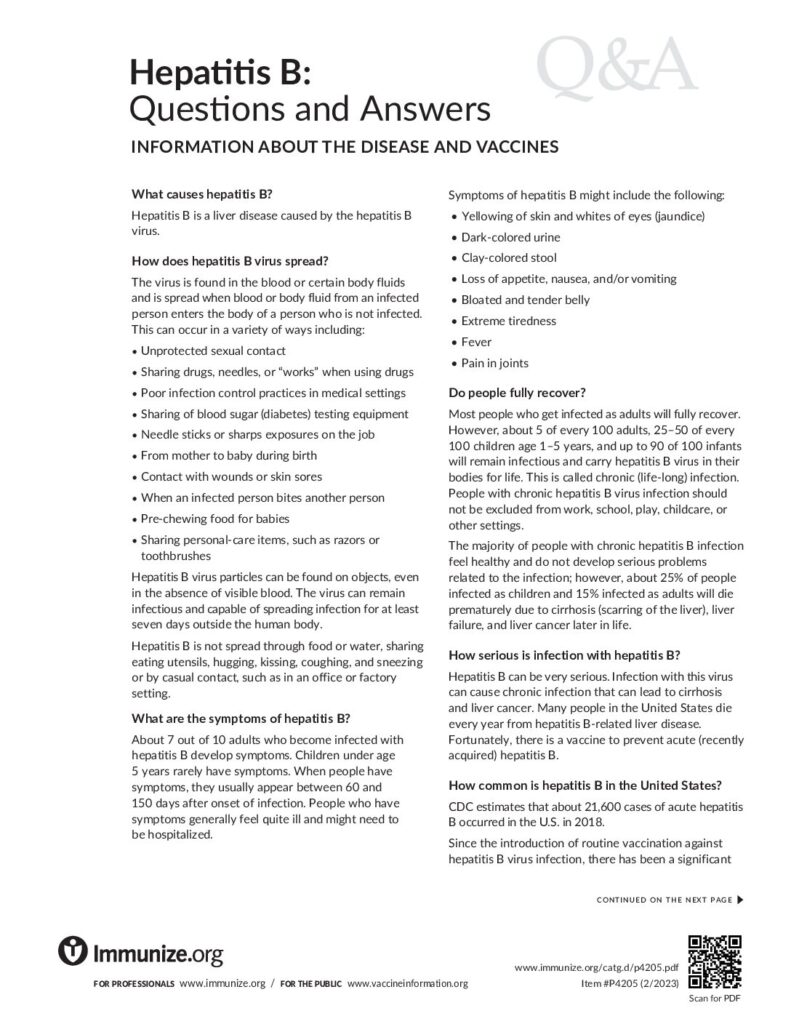
When did hepatitis B vaccine become available?
The first hepatitis B vaccine became commercially available in the United States in 1982.
In 1986, a hepatitis B vaccine produced by recombinant DNA technology was licensed, and
a second recombinant-type hepatitis B vaccine was licensed in 1989.
What are the names of the hepatitis B vaccines available in the United States?
The two recombinant vaccines (Recombivax HB® and Engerix-B®) are the only hepatitis B
vaccine preparations currently used in the United States. (There are additional products
licensed in the U.S. that contain these vaccines in combination with other vaccines.)
What kind of vaccines are they?
The hepatitis B vaccines used in the United States are recombinant DNA vaccines, which
means they are produced by inserting the gene for HBV into common baker's yeast where
it is grown, harvested, and purified. HBV infection cannot occur from receiving hepatitis
B vaccine.
How is this vaccine given?
Hepatitis B vaccine should be given to
infants (12 months of age and younger) in the thigh muscle. Either the thigh or
the upper arm muscle may be used for young children. The upper arm muscle is the
preferred site of administration for adolescents and adults. Hepatitis B vaccine
should always be given into the muscle despite the age of the patient.
Who should get this vaccine?
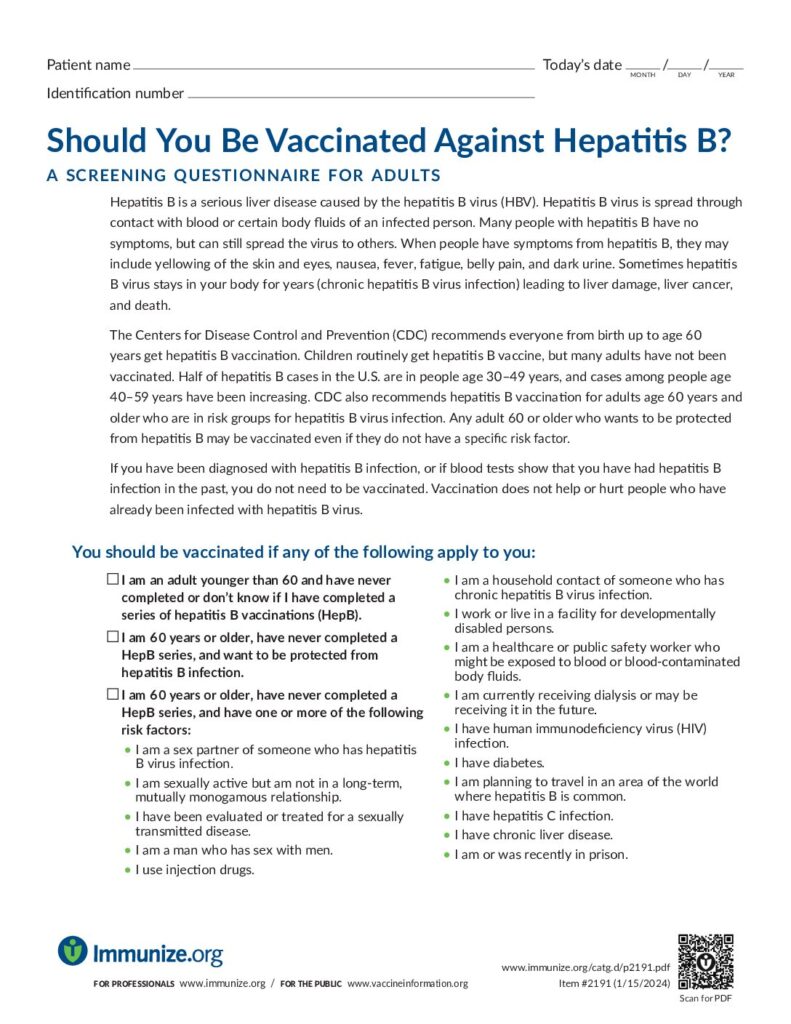
Hepatitis B vaccine, usually a three-dose series, is recommended for all children 0-18 years
of age. It is recommended for infants beginning at birth in the hospital. All older children
who did not get all the recommended doses of hepatitis B vaccine as an infant should
complete their vaccine series as soon as possible. Most states require hepatitis B vaccine for
school entry. Adolescents who are just starting their series will need two or three doses,
depending on their age and the brand of vaccine used. Adults at increased risk of acquiring
HBV infection should also be vaccinated. In addition, the vaccine can be given to any
person who desires protection from hepatitis B.
What groups of adults are at increased risk of HBV infection?
- Healthcare workers and public safety workers with reasonably anticipated risk for
exposure to blood or blood-contaminated body fluids
- Men who have sex with men
- Sexually active people who are not in long-term, mutually monogamous
relationships
- People seeking evaluation or treatment for a sexually transmitted disease
- Current or recent injection drug users
- Inmates of long-term correctional facilities
- People with end-stage kidney disease, including predialysis, hemodialysis, peritoneal
dialysis, and home dialysis patients
- Staff and residents of institutions or group homes for the developmentally
challenged
- Household members and sex partners of people with chronic HBV infection
- Susceptible (non-infected) people from United States populations known to
previously or currently have high rates of childhood HBV infection, including
Alaska Natives, Pacific Islanders, and immigrants or refugees from countries with
intermediate or high rates of chronic HBV infection. To see a list of these countries,
go to
http://www.cdc.gov/ncidod/diseases/hepatitis/b/country_listing.htm
- International travelers to regions with high or intermediate rates of HBV infection.
To see a list of these countries, go to
http://www.cdc.gov/ncidod/diseases/hepatitis/b/country_listing.htm
In addition, any adult who wishes to be protected from HBV infection should be
vaccinated without having to acknowledge a specific risk factor.
If you have not been fully vaccinated with hepatitis B vaccine and you are
cared for in any of the following settings, you should ask the setting's
healthcare provider to fully vaccinate you with hepatitis B vaccine. These
setting include:
- Sexually transmitted disease treatment facilities
- HIV testing and treatment facilities
- Facilities providing drug-abuse treatment and prevention services
- Healthcare settings targeting services to injection drug users
- Correctional facilities
- Healthcare settings targeting services to men who have sex with men
- Chronic-hemodialysis facilities and end-stage renal disease programs
- Institutions and nonresidential day care facilities for developmentally challenged
people
Who recommends this vaccine?
The Centers for Disease Control and Prevention (CDC), the American Academy of
Pediatrics (AAP), the American Academy of Family Physicians (AAFP), the
American College of Physicians (ACP), and American College of Obstetricians and
Gynecologists (ACOG) recommend this vaccine.
Is hepatitis B vaccine safe?
Yes. Hepatitis B vaccines have been demonstrated to be safe when administered to
infants, children, adolescents, and adults. Since 1982, more than an estimated 70
million adolescents and adults and more than 50 million infants and children have
received at least one dose of hepatitis B vaccine in the United States. The majority
of children who receive this vaccine have no side effects. Serious reactions are rare.
What side effects have been reported with this vaccine?
Of those children experiencing a side effect, most will have only a very mild
reaction, such as soreness at the injection site (fewer than one out of three children)
or low-grade fever. Adults are slightly more likely to experience such mild
symptoms. Serious allergic reactions following hepatitis B vaccination are rare.
How effective is this vaccine?
After three properly administered doses of vaccine, at least 9 out of 10 healthy young
adults and more than 9 out of 10 infants, children, and adolescents develop
protective antibodies and subsequent immunity to HBV infection.
Why is this vaccine recommended for all babies when most of them won't be
exposed to HBV for many years, if then?
There are three basic reasons for recommending that all infants receive hepatitis
B vaccine, starting at birth.
First, babies and young children have a very high risk for developing chronic HBV
infection if they become infected at a young age.
It is estimated that about 1 out of 3 of the nearly 1 million Americans with
chronic HBV infection acquired their infection as infants or young children.
Those with chronic HBV infection are most likely to spread the infection to
others. Infants and children who become chronically infected have an increased
risk of dying prematurely from liver cancer or cirrhosis.
In contrast to other vaccine-preventable diseases of childhood, HBV infection in
infants and young children usually produces no symptoms. Thus, the small number
of reported cases of hepatitis B among children represents the tip of the iceberg of
all HBV infections in children. For every child with symptoms of hepatitis B, there
are at least 100 HBV-infected children with no symptoms---hence the increased risk
to spread the infection to others without knowing it.
Second, early childhood infection occurs. About 16,000 children under 10 years of
age were infected with HBV every year in the United States before routine infant
hepatitis B vaccination was recommended. Although these infections represented
few of all HBV infections in the United States, it is estimated that 18 out of 100
people with chronic HBV infection in the United States acquired their infection
during early childhood. Clearly, infections occur among unvaccinated infants born
to mothers who are not HBV-infected. In addition, unvaccinated foreign-born
children account for a high proportion of infections. More effort needs to be placed
on vaccinating these unprotected children.
Most early childhood spread of HBV occurs in households where a person has
chronic HBV infection, but the spread of HBV has also been recognized in daycare
centers and schools. The most probable ways children become infected with HBV
are from skin puncture (e.g., biting) or from having their mucous membranes or cuts
and scratches come in contact with infectious body fluids from an HBV-infected
person. HBV remains infectious for at least seven days outside the body and can be
found on and spread through sharing of inanimate objects such as washcloths or
toothbrushes.
Third, long-term protection following infant vaccination is expected to last for
decades and will ultimately protect against acquiring infection at any age.
Why should your child be protected against hepatitis B if h/she won't ever
inject drugs or be sexually promiscuous?
HBV can be transmitted in many ways in addition to sex contact and injection drug
use. On average, an unvaccinated baby born in the United States has 5 out of 100
chances of developing HBV infection sometime during his or her lifetime. By
avoiding obvious means of exposure, people can reduce their odds of becoming
infected. But while there are degrees of risk involved in contracting HBV infection,
there is no such thing as "no risk." Moreover, hepatitis B vaccine is the first vaccine
to prevent cancer--HBV-related liver cancer.
Read "Unusual Cases of Hepatitis B Virus Transmission (Spread)" for examples
of the spread of HBV in a variety of settings.
Will your child need a booster shot later in life?
At the present time, booster doses are not recommended routinely for people with
normal immune systems. Although the level of protective antibodies in the blood of
a vaccinated person seems to decline with time, the immune system retains an
immunization "memory" and if the person is exposed to HBV, the system "kicks in"
and provides the needed protection.
Experts are continuing to monitor the long-term effectiveness of hepatitis B vaccine
and will issue recommendations on the need for booster doses if evidence shows that
booster doses are necessary.
Should I be tested before I get the vaccine to see if I'm already infected or
immune?
Blood testing before vaccination is not recommended for the routine vaccination of
infants, children, and adolescents. However, certain children, such as those born in
countries where HBV is moderate or highly endemic (see
www.cdc.gov/ncidod/diseases/hepatitis/b/country_listing.htm for a list of
these countries), should be tested to be sure they are not already infected. Testing
can be done at the same visit when the first dose of hepatitis B vaccine is given.
Vaccinating a person already immune to or infected with HBV will not help or harm
the person.
The main reason for testing people at increased risk for HBV is to determine if they
are infected. If after testing they are found to be infected, they must be referred to a
health professional for ongoing medical care for chronic HBV infection.
Should I get my blood tested after getting the vaccine series to make sure it
worked?
Testing after vaccination is not recommended routinely. Testing after
vaccination is recommended only for people whose medical care depends on
knowledge of their response to the vaccine. This includes infants born to HBV-infected
mothers; healthcare and public safety workers at risk of continued exposure to
blood on the job; immune compromised people (e.g., people with AIDS or on
hemodialysis); and sex and needle-sharing partners of people with chronic HBV
infection. Testing for babies born to HBV-infected mothers should be done after
completion of at least 3 doses of a licensed hepatitis B vaccine series, at age
9-18 months (generally at the next well-child visit). Testing for other persons
should be performed 1-2 months after the last dose of vaccine.
What should be done if a person gets the first two doses of hepatitis B
vaccine but never goes back for the final dose? Should the series be restarted?
No, the series does not need to be restarted. If the series is interrupted after the
first dose, the second dose should be given as soon as possible; the second and
third doses should be separated by an interval of at least 8 weeks. If only the third
dose is delayed, it should be administered as soon as possible.
The minimum recommended dosing intervals are 4 weeks between the first and
second doses and 8 weeks between the second and third doses. The minimum
interval between the first and third doses is 16 weeks.
Who should NOT receive hepatitis B vaccine?
People who had a serious allergic reaction to one dose of hepatitis B vaccine should
not have another dose of hepatitis B vaccine. People with a history of
hypersensitivity to yeast should not receive this vaccine. People with a moderate or
severe acute illness should postpone receiving the vaccine until their condition is
improved.
Can I get this vaccine when I am pregnant?
Yes.
I'm an adult who wants hepatitis B vaccination. How can I pay for the shots?
If you have insurance, the cost of hepatitis B vaccination might be covered. If not,
these shots are often available at low cost through special programs or from health
departments. Call your local health department for details.
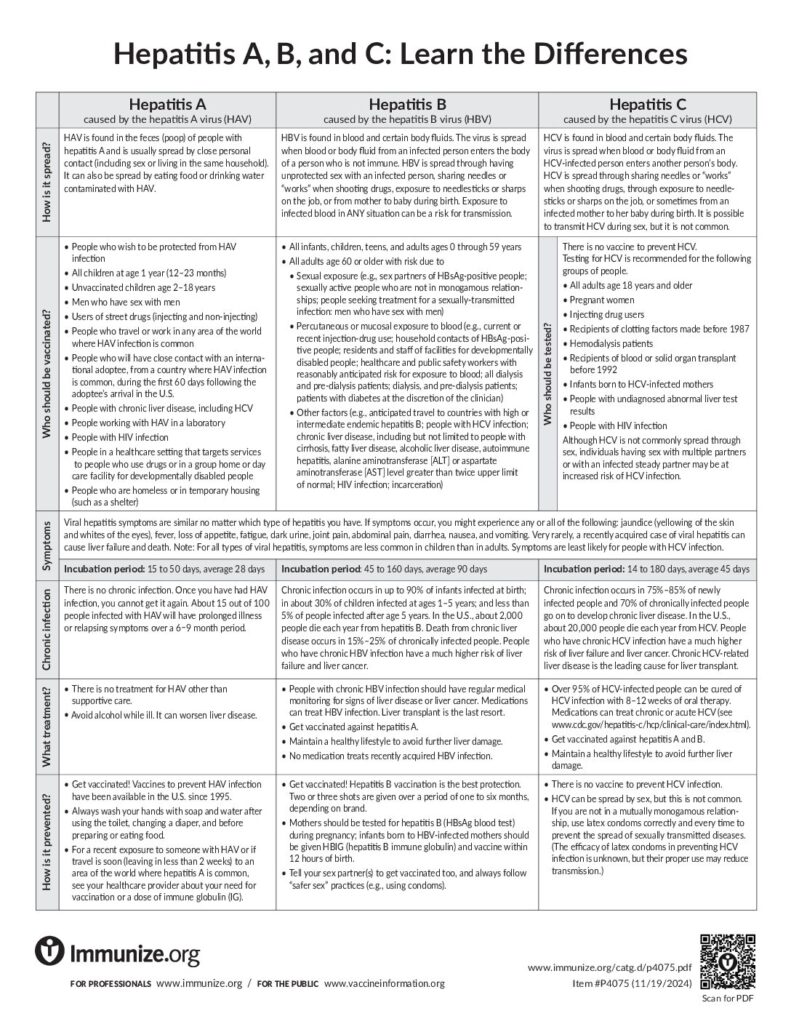
Will hepatitis B vaccination protect me from hepatitis A or hepatitis C?
No. Hepatitis A and hepatitis C are different diseases caused by different viruses.
There is a vaccine for hepatitis A, but there is no vaccine for hepatitis C at this time.
For information on hepatitis A and hepatitis C, talk to your healthcare professional,
call your local health department, or visit
www.immunize.org and
www.cdc.gov/hepatitis
Questions and answers
about hepatitis B disease
This page was reviewed on May 5, 2008
Back to top
Back to hepatitis B index page
Back to vaccineinformation.org homepage
|