|
Questions & Answers
Click
here for a
fully formatted PDF version of these Qs & As.
When did HPV vaccine become available?
On June 8, 2006, the Food and Drug Administration (FDA) licensed the first
vaccine developed to prevent cervical cancer and other diseases in females
caused by certain types of genital human papillomavirus (HPV). The vaccine,
Gardasil (by Merck), protects against four HPV types which are responsible for
70% of cervical cancers and 90% of genital warts.
What kind of vaccine is it?
HPV vaccine is an inactivated (not live) vaccine.
How is this vaccine given?
This vaccine is given as a shot in the muscle.
Who should get this vaccine?
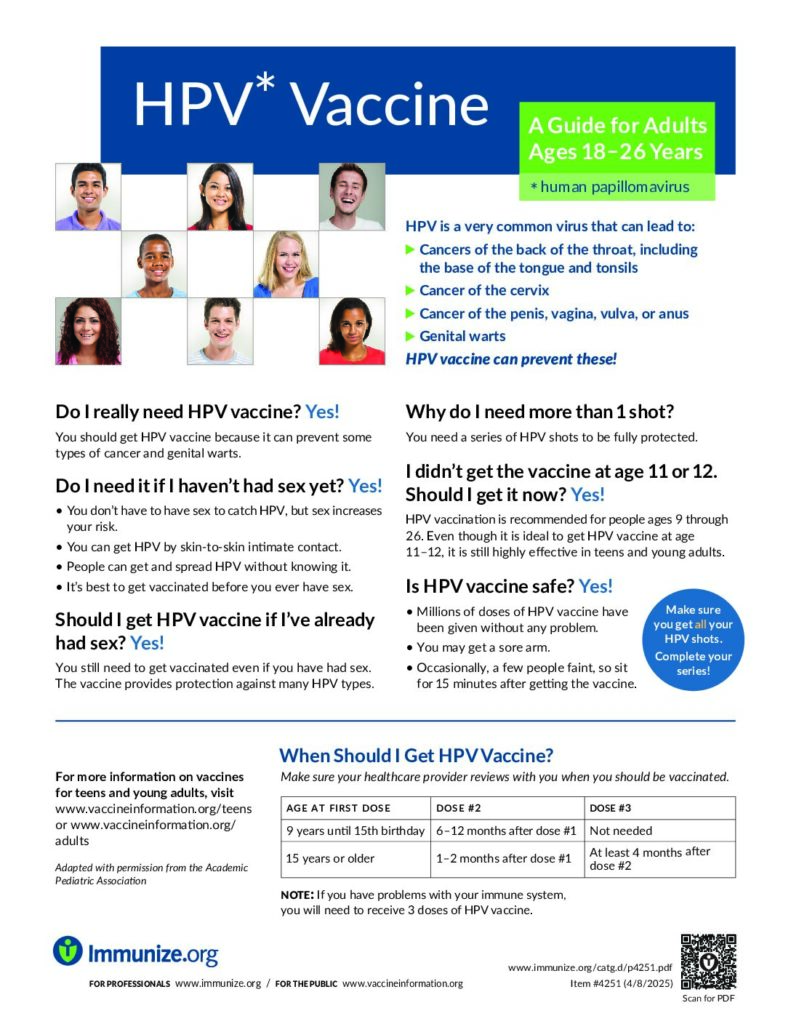
The HPV vaccine is recommended for girls age 11-12 years, but can be
administered to girls as young as age 9 years. The vaccine also is recommended
for females age 13-26 years who have not yet received or completed the vaccine
series.
The vaccine should be given as a series of three
injections over a six-month period. The second and third doses should be given
two and six months after the first dose. The vaccine can be administered at the
same visit as other needed vaccines.
It is best if the vaccine is given before onset
of sexual activity. However, females who are sexually active also may benefit
from vaccination. Females who have not been infected with any vaccine HPV type
would receive the full benefit of vaccination and those who already have been
infected with one or more HPV type would still get protection from the vaccine
types they have not acquired. Few young women are infected with all four HPV
types in the vaccine.
HPV vaccine can be given to females who have an
abnormal Pap test or genital warts. However, the vaccine will not have any
helpful effect on existing Pap test abnormalities, HPV infection, or genital
warts.
Why is the HPV vaccine recommended for such
young girls?
This is because the vaccine is most effective in girls/women who have not yet
acquired any of the four HPV types covered by the vaccine. Girls/women who have
not been infected with any of those four HPV types will get the full benefits of
the vaccine.
Why is the HPV vaccine only recommended for
girls/women age 9–26 years?
The vaccine has been widely tested in females age 9-to-26 years. Research on the
vaccine’s safety and efficacy has only recently begun with older women. The FDA
will consider licensing the vaccine for these women when there is research to
show that it is safe and effective for them.
What about vaccinating males?
Studies are now being done to find out if the vaccine works to prevent HPV
infection and disease in males. When more information is available, this vaccine
may be licensed and recommended for them as well. HPV vaccine could protect men
directly by preventing penis and anus cancer and also women indirectly, by
preventing HPV infection being passed along to them during sexual contact.
Should individuals be screened before getting
vaccinated?
No. Girls/women do not need to get an HPV test or Pap test to find out if they
should get the vaccine. An HPV test or a Pap test can tell that a woman may have
HPV, but these tests cannot tell the specific HPV type(s) that a woman has. Even
individuals with one HPV type could get protection from the other vaccine HPV
types they have not yet acquired.
How effective is this vaccine?
Four studies, one in the United States and three multinational, were conducted
to show how well Gardasil worked in women between ages 16-26 years. A total of
21,000 women were given either the vaccine or a placebo. The results showed that
in women who had not already been infected, the vaccine was nearly 100%
effective in preventing precancerous cervical lesions, precancerous vaginal and
vulvar lesions, and genital warts caused by infection with the HPV types against
which the vaccine is directed.
Two studies measured the immune response to the
vaccine among younger females age 9-15 years. Their immune response was as good
as that found in 16-26 year olds, indicating that the vaccine should have
similar effectiveness when used in this younger age group.
How long does vaccine protection last? Will a
booster shot be needed?
The length of immunity is usually not known when a vaccine is first introduced.
So far, studies have shown women to still be protected after five years. More
research is being done to find out how long protection will last, and if a
booster dose will eventually be needed.
Who recommends this vaccine?
The Centers for Disease Control and Prevention (CDC), the American Academy of
Pediatrics (AAP), and the American Academy of Family Physicians (AAFP) all
recommend this vaccine. The vaccine is also recommended by the American Cancer
Society.
How safe is this vaccine?
The HPV vaccine has been tested in over 11,000 females (age 9-26 years) in many
countries around the world, including the United States. These studies found
that the HPV vaccine was safe and caused no serious side effects. A
post-licensure safety monitoring plan is in place.
What side effects have been reported with
this vaccine?
Mild problems may occur with HPV vaccine, including pain at the injection site
(8 people in 10), redness or swelling at injection site (1 person in 4), mild
fever (1 person in 10), itching at the injection site (1 person in 30), moderate
fever (102°F) (1 person in 65). These symptoms do not last long and go away on
their own.Fainting has been reported among adolescents who receive HPV vaccine
(and other recommended vaccines as well). It’s best for the patient to sit
during vaccine administration and then wait at the clinic for 15-20 minutes
after getting vaccinated.
Like all vaccines, HPV vaccine will be monitored
for more serious or unusual side effects.
We've heard stories in the media lately about
severe reactions to the HPV vaccine. Is there any substance to these stories?
No. In summer 2008 some concerns were raised over two issues--reports of
deaths and reports of Guillain-Barré syndrome (GBS) reported to the Vaccine
Adverse Events Reporting System(VAERS) following vaccination with Gardasil. CDC
reported that there was not a common pattern to the deaths; if there had been a
common pattern, it would suggest the deaths might be caused by the vaccine. FDA
and CDC reviewed the reports and found no evidence that Gardasil increased the
rate of GBS above what is expected in the population. CDC, working with the FDA
and other immunization partners, will continue to monitor the safety of
Gardasil. You can find complete information on this and other vaccine safety
issues at www.cdc.gov/vaccinesafety
Do women still need to get a Pap test if
they’ve been vaccinated against HPV?
Yes! Women should continue to receive regular cervical cancer screening for
three reasons. First, the vaccine does not provide protection against all types
of HPV that cause cervical cancer. Second, women may not receive the full
benefits of the vaccine if they do not complete the vaccine series. Third, women
may not receive the full benefits of the vaccine if they receive the vaccine
after they have already acquired HPV infection from one of the four types for
which the vaccine is preventive.
In addition, vaccinated women should continue to
practice protective sexual behaviors since the vaccine will not prevent all
cases of genital warts or other sexually transmitted infections.
Does the vaccine protect against all types of
HPV?
No, although there are more than 100 types of human papillomaviruses, only four
are covered in the vaccine. These four viruses, however, are responsible for 70%
of cervical cancers and 90% of genital warts. Because there will be 30% of
cervical cancers not prevented by the vaccine, it is important for women to
continue getting regular Pap tests.
What if a person doesn’t get all of the
recommended three doses?
It is not yet known how much protection girls/women would get from receiving
only one or two doses of the vaccine. For this reason, it is very important that
individuals get all three doses of the vaccine. If there is a gap in the
schedule longer than the recommended time, the series should just be continued
from where it left offthere is no need to start the series over. A woman can
and should complete the series even if she is older than age 26 years.
Do women whose sexual preference is women need
HPV vaccine?
Yes. Eligibility for HPV vaccine is not determined by sexual preference.
Who should NOT receive HPV vaccine?
Anyone who has ever had a life-threatening allergic reaction to yeast, any other
component of HPV vaccine, or to a previous dose of HPV vaccine, should not get
the vaccine.
Pregnant women should not get the vaccine.
Although the vaccine appears to be safe for both the mother and developing baby,
this issue is still being studied. Inadvertently receiving HPV vaccine during
pregnancy is not a reason to consider terminating the pregnancy. Any woman who
learns she was pregnant when she got the HPV vaccine is encouraged to call the
HPV Vaccine in Pregnancy Registry at (800) 986-8999. Information gathered from
this registry will help experts learn how pregnant women respond to the vaccine.
Breast feeding women can safely get the vaccine.
Persons who are moderately or severely ill
should wait until their condition improves to be vaccinated.
Will the vaccine be covered by insurance
plans?
Most insurance plans and managed care plans cover recommended vaccines for
children. However, there may be a lag time after a vaccine is recommended before
it is available and covered by health plans.
The Vaccines for Children program provides free
vaccines to children and adolescents younger than 19 years of age, who are
either Medicaid-eligible, American Indian, or Alaska Native, uninsured, or
receiving care in a Federally Qualified Health Clinic or Rural Health Center.
Can the vaccine cause HPV?
No. The vaccine is inactivated so it cannot cause disease-like symptoms or HPV
disease.
Questions and answers
about HPV disease
Technically reviewed by the Centers for
Disease Control and Prevention, June 2009
Back to top
Back to HPV index page
Back to vaccineinformation.org homepage
|